 Switch Thumb
Research
I have conducted research in a variety of different fields. My research interests for graduate school are Human Computer Interaction and Computer Science Education. I was nominated for the CRA Undergraduate Research Award in 2011.
-
Processor Reliability
Project description
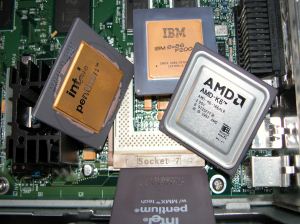
As semiconductors decrease in size, the yield of processor production decreases. In order to increase this yield without increasing significantly increasing cost, we researched replicating cores and lanes in Single Instruction, Multiple Data (SIMD) processors. The design space of processors is extremely large. In order to find a processor that performs well on a series of benchmarks while minimizing cost per chip, we used Simulated Annealing to search the design space.
Since Fall 2010 Three researchers, code in C++
The results of our research have been submitted to the Design Automation Conference (DAC) for 2012. I am working with Kevin Skadron and Brett Meyer on this project. -
Control Your Typing
Project description
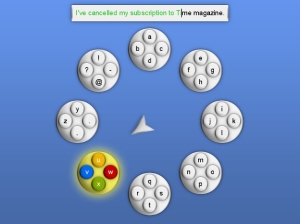
Control Your Typing began as a project for a course in Human-Computer Interaction. The project aims to improve text entry using a standard game controller. Consoles currently bring up a standard qwerty keyboard for users to navigate through letter by letter, but this is highly inefficient. Although voice entry is becoming popular, for complex messages an improved interface is necessary.
Since Spring 2011 Two researchers, code in C#
There has been some previous efforts to explore new interfaces; we will suggest a new interface and compare it against other proposed alternatives. The project can be downloaded here. I am working with Andrew Gaubatz on this project. -
The Physics of Traffic Jams
Project description
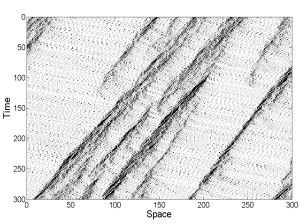
I spent my summer in between High School and College at the Weizmann Institute of Science in Rehovot, Israel as part of the the International Summer Science Institute (ISSI). There I conducted research on how traffic jams propogate by writing the Nagel-Schrekenberg Model and then extending it to two lanes of traffic.
Summer 2008 Two researchers, code in Java
The image on the left is our two-lane traffic model. Traffic jams, which are large clusters of black, propogate backwards on roads as time progress. Cars accelerate quickly upon leaving the jam ad don't slow down until they reach another jam.